Showing posts with label training. Show all posts

Wednesday, 5 February 2020

Here's a conundrum ...

You're manning reception (or these days I suppose I should say 'personning' but that just sounds silly) or working in a store and the phone goes. At the same time a customer walks up to you to ask a question. Which do you attend to first? 

Or you're in a deep and meaningful conversation with your boss and the phone rings / a customer walks in. What do you do?

As I've grown older and less tolerant of poor customer service, every experience like this which isn't handled well presents an opportunity for the individual and thus the company / business / organisation to do better. There should be proper training and clear guidelines as to what is expected of everyone working for a company, and in many there are - and they get it right. Are you sure that's your business?

How important is the customer? How do you know if that's a new one on the phone waiting to give you a huge order? How do you know if the person walking in is a mystery shopper?


How often have you fumed while you travel the world virtually through call centre systems when the business you're calling about is located just down the road?

Each time I stand in line waiting for service when the person behind the counter is so busy chatting to his / her colleague about what they did the night before, or I'm fighting with a health centre receptionist to get an appointment (to which my response is usually "Three weeks? I'll either be dead or better by then"), or my local leisure centre when they can't find my booking when I made it in person the week before, I want to go straight to the person at the top and tell them there's a training need. And sometimes I do.

Why am I, as a Public Relations and Communications specialist, talking about Customer Service? Because it can make or break your business. Get it wrong and it doesn't matter how good your products or services are because your customers will go elsewhere. It'll have a direct affect on your reputation, sales and ultimately your profits. And that's the connection. That's why it's so important.

To rectify the need, my Customer Service 101 training workshop looks at the topic from a PR and Comms perspective and is going to be held in Brighton on 20th February. 

Come along for a refresher; if you're starting a business come along to ensure great Customer Service from Day One; or send your team for a couple of hours out and some fun, informal and interactive training. 

Practical tips you can put into practice straight away will put a smile on your Customer Service face. And as they say in certain establishments "Have a nice day now!"

You can book tickets at an insanely competitive price here.

Thursday, 23 March 2017

How the challenges of the newsroom create effective business learning

Interview with John Young - local TV journalist, news presenter and business owner of John Young Media

Chimera Communications' Managing Director, Jill Woolf, met up with John just after his first Newsroom Business Bootcamp in the city, and chatted to him about how and why his business John Young Media came about. 

John Young on TV
Jill: Great to see you, John. Tell me more about how your career has developed and how your Newsroom Bootcamps came about.

Like so many people, I found that after many years working for the same employer (a quarter of a century at the BBC, in my case!), I wanted to step outside of my own comfort zone. My Editor at BBC South East Today knew I was interested in schools and educational stories — so when teachers sometimes asked if he could send anybody in to talk to pupils, he would send me in. I would go to a lot of trouble to make the talks fun and interactive — the kids loved it — and I spotted a business opportunity: for a fair price that state schools could pay, create workshops that used the buzz of live TV news reporting to give pupils an in-your-face experience of deadlines, decision-making and getting things done. 

Jill: What prompted you to bring your already well-established Newsroom Bootcamp into the business arena?

Word spread — and I found business-owners and team-leaders asking if I could run the same sort of workshop for them. They, too, wanted to test themselves (and their teams) with the pressures all employees face: confidence in a meeting, dealing with change, trying things differently. After three successful pilots, I’m now finding it a wonderfully rewarding experience to bring the same sense of energy and humour to an adult audience. 

Jill: How do you feel the first one went in terms of translating from a school and college environment to working with business people?

It was a joy. Young people can be great fun to work with, but part of the challenge can be getting them to trust you at all. They may all enjoy it, but half of them may be silent, the other half boisterous. Adults are more giving and trusting from the word go! (And the coffee from an office is generally much, much better than from a staff room …).

Jill: What specific skills areas do you bring to the Bootcamp, and how did the business delegates’ responses differ from those the students?

I bring energy. I don’t use jargon. The games we play are in-your-face, sometimes challenging, but I make sure there’s a lot of laughter, too. Business delegates are often more confident and prepared to ask more questions as we go along, which gives me a chance to constantly refine the sessions to ensure it’s achieving the goals business owners want. 

Jill: What were the important take-aways for delegates to put into practice when they returned to their offices?

If you think you’re the only one in the room believing something, you’re probably not. If you’re worried you’ve been too succinct in a report you’ve written, your report is probably spot on. If you think you’d never dare to do something you’ve not done before (like reading off an autocue in front of strangers), you’re probably wrong. If you hate change, you may find it’s not as painful as you think. 

Jill: Having worked with you on the first one, I know we’re hoping this will be the start of a series of Bootcamps. What key messages would you like to get across to those who might be thinking of joining us for the next one?

We can all learn from each other. My 25 years in live broadcasting don't give me a single academic qualification in team dynamics — but that’s probably a good thing, because it means I’m not going to drown you in a PowerPoint riddled with industry jargon. But those 25 years do give me a lot of hugely exciting experiences to share with other people, giving us all new ideas about how to be effective in the workplace. 

Jill: What inspires you, John? What makes you get up in the morning and look forward to the day?

A ‘thank you’ letter I received last month sums it up for me — from a 15-year-old girl who struggled at school. She had actually sat down to write it to thank me for giving her confidence during my Employability Express workshop. Here’s what Georgia wrote: 

"You taught me so much, such as getting out of my comfort zone, how to talk in meetings and how to present yourself and you kept on pushing us to work harder and to challenge ourselves. The part I found the most challenging was getting chosen to read off the auto-cue when I didn’t want to. It freaked me out as I don’t like standing up in front of everyone and reading aloud. Although I found it hard to do that, it really helped me and now I feel more confident in myself.”

Jill: What are the best and worst things about your news presenting job, and have these influenced the way you put together the Bootcamps?

Worst thing? There are very few — I’m lucky enough to love the whole process. What we call a ‘quiet news day’ can be frustrating — we like to go on air with compelling news stories, and let’s face it … not all days are as busy as others! The best thing? Knowing that reporting people’s stories can often help them … and knowing that, even if the day hasn’t gone the way you’d hoped, tomorrow is an entirely new news day … 
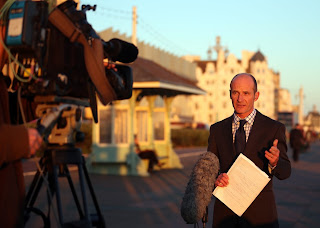
John Young in front of the camera


Jill: Do you have three top tips for those who didn’t attend the first Newsroom Business Bootcamp?

Less is more — when you’re writing a report, think about a ‘headline’ for it first … because that may be the only bit anyone remembers. 

Don’t be afraid of changing something at the last minute — it can be easier than you think, and nobody’s going to know what you didn’t do or say anyway. 

You have a right to believe what you believe — and you may be surprised how many other people are thinking what you’re thinking, even if you’re the only one that says it out loud.

Jill: I’m inspired! Thanks so much, John.

John: My pleasure.

This piece was originally published on the Brighton & Hove Chamber of Commerce website. Jill Woolf is Lead Ambassador and a Vice-President of the Chamber www.businessinbrighton.org.uk 


Thursday, 21 July 2016

The Case of Noddy and the Mysterious Media Interview


Well, at least that got your attention!

Can you remember the worst interview you’ve ever seen on TV? I bet you can. Was it a politician, reality ‘star’, footballer or unsuspecting member of the public?

For me, it was the director of a certain holiday park company who was being grilled by a prime time TV reporter about some pretty torrid holiday experiences from customers at one of their venues. This was a perfect example of media training - or in this case, lack of media training.

The company representative continually denied everything, was incredibly defensive to the point of being downright aggressive in tone as well as body language, was utterly disinterested in the customers’ complaints, and frankly made viewers feel they’d never want to use that holiday firm in the future.

How different it could have been. The right spokesperson, preparation, tone, language and message delivery could have been the difference between:

(a) alienating the reporter as well as the viewer;
(b) getting the company perceived as caring, considerate and responsive; and
(c) winning and losing customers.

Have you worn the right outfit for the interview?

There are so many things to consider when agreeing to appear on TV or on the radio, or on-line, and that’s where we come in.

Our media trainers are experienced broadcasters, journalists and communications experts, not wannabes or copycats.

We will create a bespoke training course for your business and its issues, and deliver it at your own offices or venue of choice. It can last as long as you want it to ie half a day, a whole day or two. It depends how many people are to be trained and how much content we agree with you will benefit your executives. We also incorporate personal branding and image.

We work with a professional filming crew, so everyone will be filmed and critiqued (in only the most positive way), then we go about giving you expert tips and techniques to hone your skills and make you feel confident and controlled for future broadcasts. The experience takes away the mystique and fear, and having been through it once, you’ll feel much better about doing it for real when the need arises.

“This was one of the best courses I’ve ever been on, and I remember your tips to this very day,” said one of my delegates, a director from a housing group, “even down to the choice of tie I should wear!”

And Noddy? 

It’s the name for those little head shots you see in interviews consisting of nods or signs of listening by the interviewer. Usually it’s because there’s only one camera available, and noddies are recorded after the interview has taken place then edited in. It seems real to the viewer, as if the interview is being filmed from several different angles with a bigger film crew.

Get in touch now to talk about the creation of a bespoke package for your company executives. Simply click here or give us a call.

Your company reputation is worth it.


Monday, 20 June 2016

“Don't let's ask for the moon! We have the stars!” ― Olive Higgins Prouty, Now, Voyager

Last week, our training team had some fresh professional photos taken by our lovely friends at VERVATE in Brighton.

The original plan was to use the seafront as our stage and create some rather wacky shots but as the heavens opened, Plan B came into operation: we used the theatre and stage setting at 88 London Road, an independent CIC (community interest company) where the current performance is Peter Pan, a musical adventure. We're strategic PR partners with the 88 team, so we have very special access.

Having professional images means projecting a professional image and with our quirky company, only quirky images would do. Effective branding means always being consistent and cohesive, and that includes business photography. We're vibrant personalities, our offering is strategic and business-like, so having us stand dumbly in a straight line just wouldn't be appropriate.

So here are some of the images we created, thanks to the wonderful Susi Doherty and Simon Dack of VERVATE. "Do something funky" I said and that's just what we got. Where else would I get the chance to lift up the moon?!
We can't get you to the moon but we can help your business fly!

So here we have from left to right, back row: Pete Jenkins (Gamification+), Jill Woolf, Chris Cummings (OGC Solutions); front row: Eleanor Dobing, Susi Doherty (VERVATE), Sheryl Tipton and Samantha Wilding. Missing from the trainers' line-up is Barney Durrant (Bluebell Digital). 

This unique team of industry experts is collaborating to bring small business owners and their teams a range of PR, sales and marketing-related training workshops designed to create better performance, enhance skills and improve profits.

It's no good waiting in the wings, dreaming you'll get to Neverland, wishing you could fly and hoping the business spotlight will fall on you, centre stage. Enough with the Peter Pan theatre puns! You need to invest in your people so your business can experience return on investment.

We can't get our clients to the moon but our selection of perfectly crafted topics, from content marketing through gamification, social media, photography, getting your business story in the media, plus tons of other sessions, can certainly make you superstars in your own right.

All of our trainers have real experience in the topics about which they're coaching, and have worked with every type of organisation from start-ups, social enterprises, SMEs, multinational conglomerates and everything in between. Between us, we have around 200 years' experience. This unique mix isn't replicated anywhere else.

Go on, book an Early Bird ticket now and say 'Curtains up' for business growth.

Each and every one of them a training superstar!
 To book, go to Chimera Courses - practical skills for practical businesses.


Monday, 11 April 2016

Epic photography for business

People engage more through a powerful image than text. That’s why you should use the best possible photography for business. It’s a no-brainer yet it’s amazing how many people use out-of-focus, badly lit and unclear images.

Oops!
Impactful photography is crucial to promoting your business especially with the power and immediacy of social media. That means using relevant images.

It’s also essential to have an approachable, professional-looking photograph of yourself so your potential customers can see the face behind the business, making it more personal. People are more likely to do business with someone they know and trust which is why you should have an image as your avatar on social media, rather than the default ‘egg’.

Your products and services should have fantastic professional-looking photography too although sometimes you might not have sufficient budget to hire a photographer.  Well taken photos will enhance your organisation’s PR whether it’s online or on printed media. Flyers, exhibition material and leaflets are much more likely to be read if they are covered with eye-catching imagery.

With the advent of mobile devices with good camera facilities, you can create good photos yourself although for high-level corporate work, you should still try to find budget for a professional photographer if you can.

You can get stock images from the internet but beware copyright and licensing laws.
If you decide to take your own photos, you need to consider subject, lighting, composition, quality etc and be aware your brand reputation might be tarnished if you don’t do it well.

Please don’t assume images you find on Google are free to use. From the time an image is created it is automatically protected by copyright, which is protection provided by the law applying to all images. To use an image without having permission or purchasing a licence is known as infringement. 

Infringement of copyright can be very costly and result in lawsuits, legal fees and even criminal charges. There are ways you can be found out if you think your use of an image from the internet can’t be tracked, so beware!

Now that local papers particularly have fewer staff photographers, they’re on the look-out for creative images to be sent in … but only if they’re good quality, in the right format and size, and tell a story.

To find out lots more about this subject, check out our #ChimeraCourse photography session: www.chimeracomms.co.uk/courses.php

Think of the damage limitation involved if you get it wrong!


Friday, 8 April 2016

Training? Bah humbug!

Giving your teams the skills to do their jobs properly is good for your business and good for everyone.

Training and development improves your business through performance, profit and staff morale. 

Naturally anyone who’s tasked with doing a job needs to know how to do it, yet firms often give people an additional remit but don’t train them. It’s as if there’s an expectation they’ll suddenly know how, which means that probably the job will get done badly or not at all. Wasted time, possibly damaged organisational reputation and certainly a frustrated team member.

Key benefits of giving your teams the training they need:

·         better customer service through better communication
·         improved productivity and profit
·         people who feel up-to-date on latest technology or industry best practice 
·         better loyalty and retention as people feel you’ve invested in them
·         retention saves you money

In addition, your people will have valuable new skills, increasing their contribution to the business and building their self-esteem. The training they do can take them into other positions within the organisation, positions with better prospects and/or better pay and which help your business. And they have fresh skills to do new and different tasks, which keeps them motivated and fresh.

So if you think training is a waste of time or resources when people should be at their desks, think again. If you don’t train your teams to communicate better, your key messages won’t be getting to the right customers or potential customers. That could be wasting the money you might already be spending on PR and marketing, and damaging your organisational reputation.

What if they take the training then disappear to a competitor, you ask. That's life. As I always say, it's the real world. Stuff happens. Deal with it but don't dwell on it.

If you’re using so-so photography to promote your business, you’re wasting time and money, and giving your competitors the edge.

If your personal brand doesn’t match that of your organisation or business, you’re potentially damaging your chances of success.

And if you want to know how to use social media to promote your organisation effectively, don’t just assume everyone can do it. It could all go horribly wrong!

Check out #ChimeraCourses – a range of training sessions with skilled, experienced and knowledgeable industry experts not copycats or wannabes www.chimeracomms.co.uk/courses.php


Don’t be a training humbug. Skills are for life, not just a sweetener!

Monday, 15 June 2015

My favourite new way to learn : webinars


I love webinars.

In what other context can you join experts in their field without having to leave your home or office, have the ability to raise any number of pertinent questions, wear your PJs if you want (if you work from home, naturally!), avoid hideous traffic jams/train delays/arriving late through no fault of your own and upsetting rows of tutting people, all for free and at a time that (more often than not) suits you?

OK, so some are in the middle of the night if they’re in a different time zone. But you can always ask to see the webinar afterwards.

And that’s another thing. I love that you get access after you’ve attended a webinar just in case you missed something or want to revisit a particular point.

Would it benefit you to hold one, or more? Here’s why you should consider being a webinar host:

You get to reach the people you want to reach – in a session that almost feels like it’s one-to-one
Find out what your target audiences want to hear about; it’ll show you what’s hot and what’s not in your sector. People are more likely to ask questions during a webinar without having to worry about putting their hands up in front of others, if they’re of a timid nature.

You can get across your key messages without sounding like you’re ‘selling’ and therefore people will be more likely to respond favourably.

Increase the reach – a webinar is for life, not just for the moment
Your messages will live on after the webinar is finished, through the ability to let people see it after broadcast. So don’t forget to give it some SEO welly too so you edge up those Google rankings.

Use different ways to grab interest
Show the breadth of your expertise by reinforcing what you’re saying through more than just talk. Use slides, animation, polls and any other method which captures the imagination without being visually unappealing or annoying.

Be a cheapskate
So much cheaper and easier than holding an event, webinars are also value for money as your database will grow with each one.

What’s not to love?!